Backcasting: Start With a Future, Then Walk It Back
Backcasting helps a team trace a possible future to present-day choices, exposing dependencies and showing which small, responsible move makes sense now.
The common mistake in backcasting is to write an attractive future and treat the route to it as obvious. That can leave a team with a polished vision but no clear next decision. Backcasting works in the opposite direction from forecasting: start with a future worth examining, then trace backward to the conditions and choices that could make it possible.
It is a way to organize decisions, not predict what will happen. Use it to expose what a preferred future depends on, distinguish choices within your control from outside conditions, and decide what is useful to learn before committing further.
Define the decision before choosing a future
Give the exercise a subject, a boundary, a time horizon, and a question. “The future of work” is too broad; “How could a regional hospital make care easier to reach while relying less on last-minute staffing?” points toward a decision people can examine.
State what the group can influence and what lies outside its authority. A city team might include bus service and public information in its scope while treating national tax policy as an external condition. Also identify whose experience matters: service users, frontline staff, operators, and people who may bear the costs of change.
Choose the format to match the disagreement. If the goal is shared, backcast from one preferred future. If people disagree about what matters, describe a few contrasting futures and work backward from each before choosing a route. If the subject is sensitive, keep the exercise exploratory and name unacceptable trade-offs.
Describe the future so people can picture its workings
A useful future statement describes what people can do and what institutions must provide, rather than relying on a slogan such as “a sustainable district.” For example, it might say residents can reach daily services without depending on a private car, deliveries fit around street activity, and people who cannot walk far have practical alternatives.
Separate that desired outcome from the assumptions supporting it. Ask what must be true about skills, public trust, legal authority, maintenance, energy, or demand. Mark uncertain conditions instead of quietly treating them as facts.
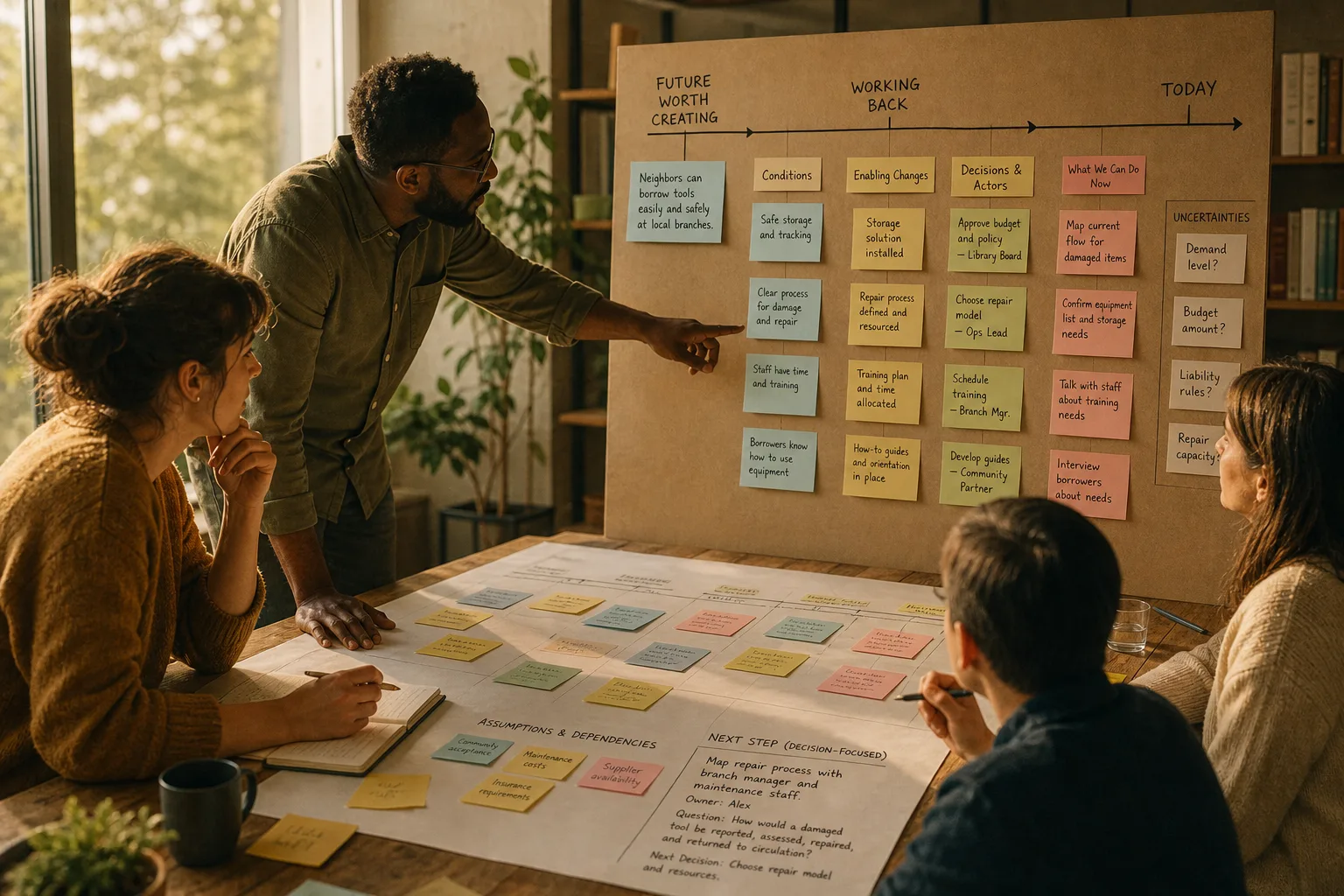
Imagine a library team wants to explore neighborhood tool lending. Its starting point is a proposal to let residents borrow household equipment at local branches. The team describes the intended service, then lists what would have to work: safe storage, a process for damaged items, staff capacity, and a way for borrowers to learn how equipment is used. The resulting description makes the service’s dependencies visible without claiming it will succeed.
Trace conditions backward into decisions
Put the future statement at one end of a board, with the present at the other. Work backward by asking what would need to exist immediately before the future could function, then what would enable that condition.
- Write the future state. Describe everyday activities and services in plain language.
- List necessary conditions. Include capabilities, rules, relationships, resources, and public acceptance; mark disputed assumptions.
- Find enabling changes. Identify what must be built, learned, approved, maintained, or stopped before those conditions can hold.
- Connect the route to the present. Name decisions or inquiries that could begin now, along with the people or institutions able to act.
- Read the route forward. Check each link for missing actors, unsupported assumptions, or dependencies that make the sequence implausible.
Use sticky notes or a shared board such as Miro so the links can move. Label notes as conditions, choices, or uncertainties. For the library scenario, the team might work backward from a functioning lending service to a repair process, then to staff training and a decision about who handles repairs. Reading forward reveals that the training plan depends on knowing which equipment the library would actually lend.
Separate the route from what the group hopes is true
A tidy chain of notes can make a fragile plan look inevitable. Show parallel routes and dependencies, and distinguish a necessary condition from one possible way to meet it. If the route depends on one supplier or an approval outside the group’s control, make that visible.
- Check the goal: If participants disagree about the outcome, then record the competing futures separately; otherwise, proceed with the shared statement.
- Check the authority: If the group cannot make a required decision, then name the institution that can and plan how to engage it; otherwise, assign an internal owner.
- Check the dependency: If one supplier, partner, or approval is indispensable, then identify an alternative or a point for reconsideration; otherwise, keep the route open for other options.
- Check who bears the work: If frontline staff or affected residents carry an unexamined burden, then ask them to review the condition and revise the route; otherwise, record who will maintain the proposed arrangement.
- Check the evidence gap: If a disputed assumption could change the next decision, then seek relevant input before proceeding; otherwise, state why it does not need to be resolved yet.
- Check for harm: If a route risks exclusion or an unfair burden, then add a safeguard or reconsider the future; otherwise, note what would trigger a fresh review.
“Could happen” does not mean “should happen.” Ask who decides, who adapts, and who may be excluded. For questions involving health, legal rights, public safety, or substantial financial commitments, use backcasting to frame issues for qualified professionals, not to replace their advice.
Choose a present-day move that answers a real question
Do not turn every note into a task. Choose an action based on the uncertainty it addresses and the commitment it requires. Interviews may clarify needs; a process map with frontline staff may expose operational gaps; a specialist may help assess a technical dependency.
For each action, name an owner, the question it addresses, and the decision that will follow. “Explore public response” is vague. “Invite renters, shop owners, and transit riders to review proposed service locations, then revise the access assumptions” makes the purpose and next decision observable.
In the library scenario, suppose the team has no agreed process for damaged tools. It asks a branch manager and maintenance staff to map how an item would be reported, inspected, and returned to circulation. The expected result is a clearer decision about whether the proposed service needs dedicated repair capacity before a lending offer can be designed.
How should you handle disagreement about the future?
Should everyone agree on one future first?
No. Record distinct futures and the values behind them before trying to combine them. Working backward from each can show whether the disagreement concerns the goal, a trade-off, or a practical constraint.
How many futures should a group compare?
Choose a small set that exposes meaningful differences without making each route difficult to examine. The right number depends on the session’s scope and the group’s time.
Can backcasting start from an undesirable future?
Yes. Use it to identify warning conditions and decisions that could reduce harm, without treating the scenario as inevitable.
What if the route depends on an outside decision?
Mark the dependency, identify who can influence it, and look for an alternate route. If none exists, delay commitments that rely on that decision and decide what change would prompt a review.
Keep the pathway useful as circumstances change
Keep the future statement beside the route, and note what would make the group reconsider its assumptions: a rule change, a stalled partnership, a new operational constraint, or a shift in public expectations. These are prompts for review, not predictions.
At a review, ask which conditions still hold and whether the next action remains useful. Remove obsolete notes, revise dependencies, and preserve more than one route where possible. Backcasting earns its place when it helps a group make a clearer present-day decision while remaining honest about what it does not control.
When searching for a backcasting method, look for a route that connects a specific future to named conditions, accountable choices, and a decision the group can make now. The map is not the achievement; its value is showing what needs attention before the next commitment.