Three Futures for the Empty Corner Shop
Three futures for the empty corner shop show how a vacant storefront could meet local needs—and what each choice asks neighbors to give up.
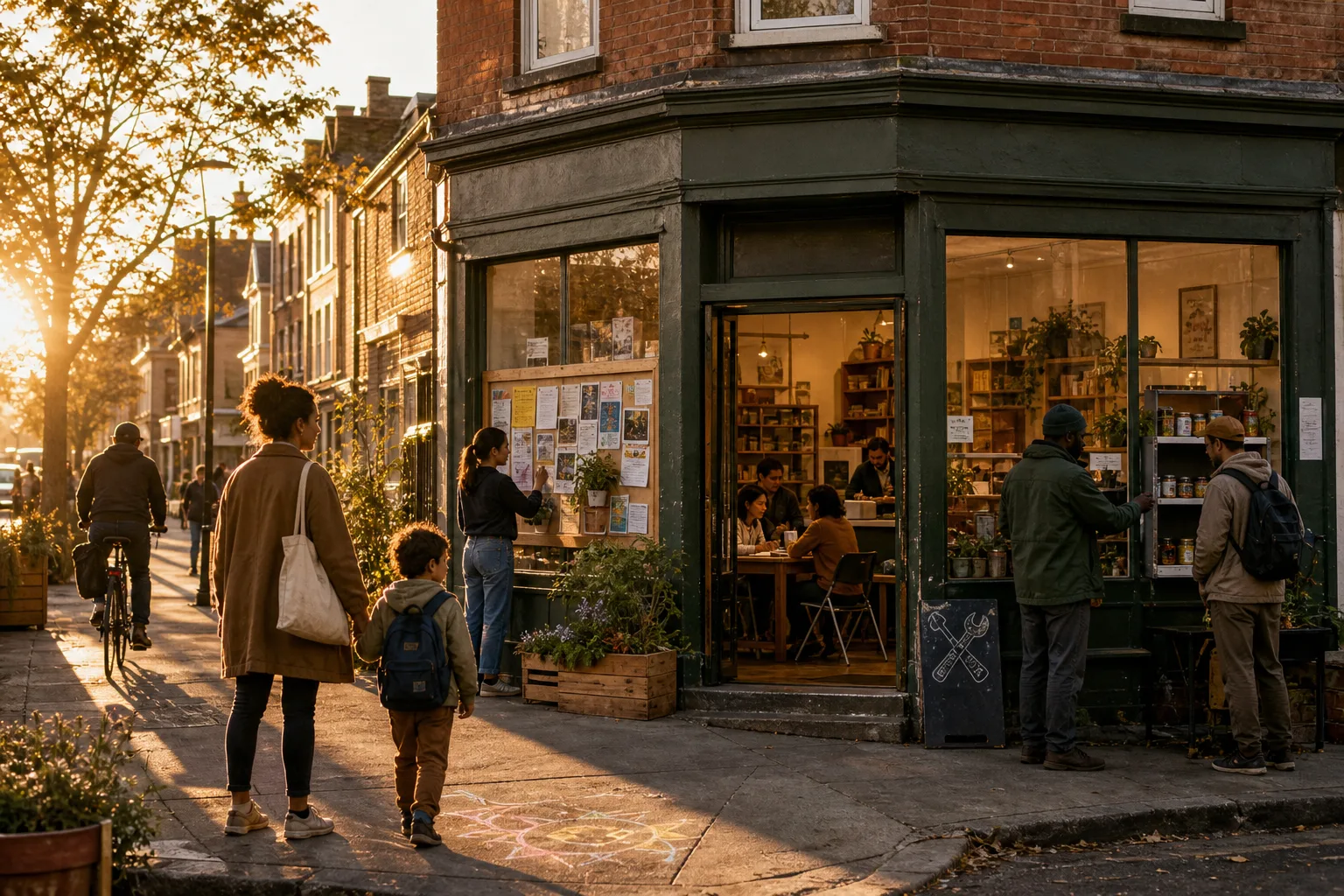
The most common mistake with an empty corner shop is to treat it as a blank canvas. That can cost a neighborhood the chance to ask what the space is actually for: a place to meet, a service people need, or a dependable source of income. Three futures for the empty corner shop make those choices visible before anyone settles on a design.
Each scenario below starts from the same familiar sight: a shuttered storefront on a residential block. The differences lie in what neighbors prioritize, who runs the space, and what they are willing to trade away. These are imagined futures, not predictions.
What could an empty corner shop become?
It could become a neighborhood commons, a small service hub, or a flexible commercial storefront. Each version answers a different question: Who needs a place to belong? What everyday task is inconvenient to reach? And can a local business survive here?
To keep the scenarios comparable, imagine the same shop on the same block, with its existing street-facing windows and modest back room. In each future, residents and the property owner make a different choice about the space’s purpose and upkeep.
How would a neighborhood commons work?
In this future, the shop becomes a low-cost gathering place. A few tables, a noticeboard, a kettle, and movable chairs make room for after-school activities, repair meetups, language exchanges, and quiet time. The windows stay clear so passersby can see what is happening inside.
The commons works best when people can use it without buying anything. That makes it welcoming to residents with little disposable income and gives local groups a place to meet without asking a café to host them. The trade-off is that someone must handle keys, cleaning, opening hours, and inevitable disputes over how the room is used.
Imagine residents begin with a weekly homework club and a monthly mending session, using folding chairs and a sign-up sheet kept at the library. If volunteers can share the opening and closing duties, the observable result would be a regular stream of neighbors using the space for different purposes. If only one organizer carries the load, activities may become sporadic or stop.
What would a local service hub offer?
A service hub puts practical errands first. It might combine parcel collection, printing, tool lending, a community fridge, or help filling out online forms. The exact mix depends on what residents cannot easily access nearby; a neighborhood map of existing services can reveal gaps before anyone buys equipment.
This version gives people a reason to drop in during ordinary routines. A parcel shelf could draw customers who then discover a tool library, while a printer might help residents who do not own one. The trade-off is complexity: each service needs clear responsibility, safe handling, and a plan for costs, privacy, and maintenance.
A hub also has to avoid becoming a catch-all for needs it cannot meet. Staff or volunteers should know where to refer someone seeking professional advice, and any service involving personal information needs careful boundaries. The shop can connect residents to help without pretending to replace qualified providers.
Could the shop become a flexible local business?
In this future, the storefront remains commercial, but its offer is shaped around neighborhood demand. It might host a baker in the morning and a prepared-food counter later, or give a local maker a small retail space alongside essential household goods. A lease or operating arrangement could allow the offer to change as residents’ needs shift.
Trading income can pay for staff and keep the doors open on a predictable schedule. A business can also make the street feel active, particularly when its windows show people making, fixing, or selling something. The trade-off is access: customers need to spend money for the model to hold up, and commercially useful space may leave less room for free gatherings.
A flexible shop still needs a clear identity. If every week brings a new offer, people may stop knowing what they can count on. A stable core—such as groceries, prepared food, or repairs—can give occasional pop-ups a reliable home.
How do these three futures compare?
The commons prioritizes access and belonging; the service hub prioritizes practical convenience; the flexible business prioritizes a durable operating model. None solves every neighborhood need, and none is automatically the fairest or most workable choice.
- Who can use it? A commons can be free, while a business depends on purchases and a service hub may mix free and paid offers.
- Who keeps it running? Volunteer coordination, trained staff, and business management require different skills and commitments.
- What must the space contain? Tables and storage suit gatherings; secure shelves and equipment suit services; counters and back-of-house space support retail.
- What would count as success? Regular participation, completed errands, or reliable trading are different signs of value.
- What could be lost? A quiet community room may not generate income; a busy shop may limit free access; a mixed-use hub may strain its operators.
These questions are more useful than asking which scenario sounds most exciting. They expose assumptions that can otherwise hide in a floor plan: that volunteers will always be available, that enough customers will appear, or that one room can support several uses without conflict.
What should neighbors ask before choosing a future?
Who is missing from the conversation?
Ask who lives nearby but is least likely to attend a planning meeting, including renters, teenagers, caregivers, and people with mobility needs. Reach them through familiar local places such as a school, library, or tenants’ group, and offer ways to respond beyond a public meeting.
What needs already have a nearby answer?
Walk the surrounding streets and note existing shops, public services, community rooms, and gaps in opening hours or access. A new storefront is more useful when it complements what is there instead of duplicating an easy-to-reach service.
Who will pay for the space and its upkeep?
Separate the cost of fitting out the shop from the continuing work of staffing, cleaning, utilities, and repairs. The property owner, a business operator, a community organization, or a partnership may take responsibility, but the arrangement needs to be explicit.
How could the first choice change later?
Look for a lease or operating plan that allows the use to evolve if the original idea attracts few users or burdens its organizers. Movable furniture and a clear review process can make adjustment easier, though building work and service commitments may still limit change.
How can the neighborhood make a decision without pretending to know the future?
Compare the scenarios against local priorities, then identify what would need to be true for each one to work. If the commons depends on a dependable volunteer rota, ask whether local groups can share the task. If the business depends on a steady customer base, ask what residents would actually buy and what else competes for their spending.
Where permission and resources allow, a short, reversible trial can reveal practical friction before a permanent fit-out. A temporary display, a pop-up service day, or a few scheduled gatherings can show whether the location is easy to enter and whether the proposed hours suit residents. Any trial should have a named organizer, a clear way to collect feedback, and an agreed point for deciding what changes.
Three futures for the empty corner shop are most useful as a conversation tool, not a menu with one perfect answer. The strongest choice is the one whose responsibilities are understood as clearly as its benefits. Before the shutter rises, neighbors can make one more decision: what evidence would persuade them to adapt the plan rather than defend it?